
Melanotan II is a synthetic peptide hormone that has been studied for its potential as a tanning agent and as a treatment for sexual dysfunction. The peptide was first synthesized in the 1990s by a team of researchers led by Victor Hruby at the University of Arizona. The development of Melanotan II was based on the discovery of the natural hormone alpha-melanocyte stimulating hormone (α-MSH), which is produced by the pituitary gland and stimulates the production of melanin in the skin.
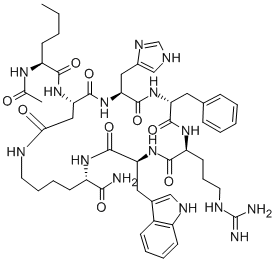 The discovery of α-MSH in the 1950s led to a great deal of interest in its potential as a tanning agent. However, the natural hormone was not practical for use as a tanning agent, as it had a very short half-life in the body and was quickly broken down. Researchers began to investigate the development of synthetic analogs of α-MSH that would be more stable and have a longer-lasting effect.
The first synthetic analog of α-MSH to be developed was Melanotan I, which was created by a team of researchers at the University of Arizona in the early 1980s. Melanotan I was found to be effective at inducing skin pigmentation, but it had some limitations. One of the main drawbacks of Melanotan I was that it had to be administered through injection, which made it impractical for use as a tanning agent.
In the early 1990s, Hruby and his team began working on the development of a second-generation analog of α-MSH, which would be more effective and easier to administer. The result of their work was Melanotan II, which was synthesized in 1996.
Melanotan II was found to be much more effective than Melanotan I at inducing skin pigmentation. In addition, it had a longer half-life in the body and could be administered through subcutaneous injection, making it more practical for use as a tanning agent. Melanotan II was also found to have some other interesting effects on the body, including its ability to stimulate sexual arousal and improve erectile function.
In the years following its development, Melanotan II gained popularity among bodybuilders and other fitness enthusiasts who were looking for a safe and effective way to achieve a deep, natural-looking tan. The peptide was also studied for its potential as a treatment for sexual dysfunction, particularly in men with erectile dysfunction.
However, as with many new drugs and supplements, there were concerns about the safety of Melanotan II. Some users reported experiencing side effects such as nausea, vomiting, and increased blood pressure. In addition, there were concerns about the long-term effects of using Melanotan II on the body, particularly its potential to increase the risk of skin cancer.
As a result, the use of Melanotan II remains controversial. While some users swear by its tanning and sexual-enhancing effects, others are skeptical of its safety and caution against its use. It is worth noting that Melanotan II is not approved by the FDA for any medical or cosmetic use, and it is illegal to sell or distribute the peptide for these purposes in the United States.
Despite the controversies surrounding its use, Melanotan II remains an interesting and promising area of research. It has the potential to offer a safe and effective way to achieve a deep, natural-looking tan, as well as a new approach to treating sexual dysfunction. However, more research is needed to fully understand the safety and effectiveness of this peptide and to develop better methods for administering it.